As an Amazon Associate, we earn from qualifying purchases. Some links may be affiliate links at no extra cost to you. Although our opinions are based on curated research, we haven't used these products. Articles generated with AI.

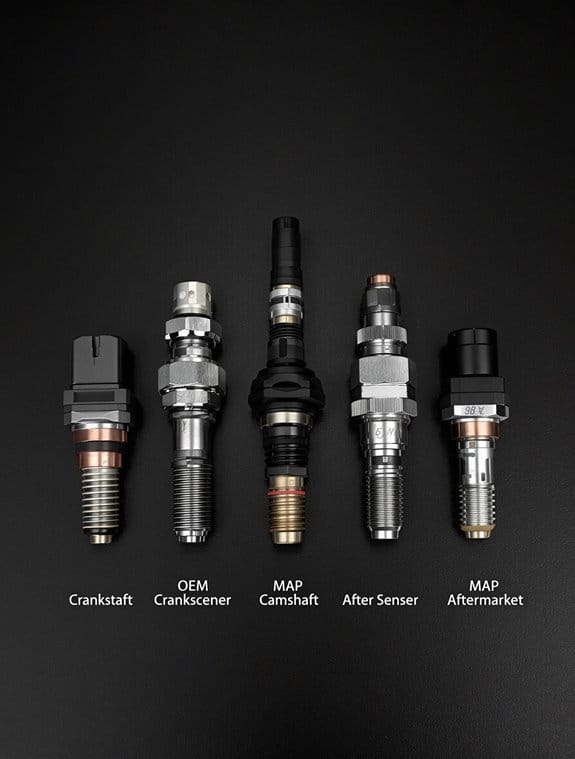
The 5 Best Honda Accord Sensors of 2026 – OEM vs. Aftermarket Comparison

When choosing Honda Accord sensors, you’ll find OEM options like the Genuine Honda Knock Sensor provide superior reliability and precise calibration despite higher costs, while aftermarket alternatives like the FainWan MAP sensor offer cost savings with potential compatibility trade-offs. The best sensor choice depends on your specific needs, with top options including O2 sensors, knock sensors, and MAP sensors from both OEM and aftermarket manufacturers. Exploring the detailed specifications and warranty coverage of each option will help guide your selection process.
Key Takeaways
- OEM Honda O2 sensors (2003-2007) deliver superior air-fuel ratio monitoring with double laser-welded construction and one-year warranty coverage.
- Genuine Honda knock sensors effectively resolve check engine issues and prevent recurrence, despite higher costs than aftermarket alternatives.
- MAP pressure sensors from both OEM and aftermarket brands offer similar compatibility, but OEM options provide better long-term reliability.
- Aftermarket sensors cost 30-50% less initially but may require frequent replacements, increasing total ownership costs over time.
- Factory-original sensors enhance vehicle resale value and provide more comprehensive warranty coverage compared to aftermarket alternatives.
O2 Oxygen Sensors (2 Pack) for 2003-2007 Honda Accord
Upstream and Downstream Oxygen O2 Sensor for Honda Accord 2003-2007 2.4L Replaces...
- 🔶【2 PCS】Including 2 Oxygen Sensor. 234-9040 Upstream Oxygen Sensor x1, 234-4797 Downstream Oxygen Sensor x1
- 🔶【OEM PART NUMBER】234-4797 234-9040 13704 2344363 36531RAAA01 36531RAAA02 36532RAAA01 36532RAAA02 36532RAAA11 36532RAD305 36532RADL11 36532RADL12
- 🔶【FITMENT】Compatible with Honda Accord DX Sedan 2003-2005/EX Coupe EX Sedan LX Coupe LX Sedan 2003-2007/LX Special Edition Sedan 2006/SE Coupe 2005/Special Edition...
Honda Accord owners looking for reliable oxygen sensor replacements will find this two-pack bundle ideal for their 2003-2007 models, featuring both upstream and downstream sensors that match OEM specifications. You’ll get precise air-fuel ratio monitoring through the double laser-welded stainless steel construction that enhances engine performance.
The package covers multiple trim levels, including DX, EX, LX, and Special Edition variants with 2.4L four-cylinder engines. With OEM-equivalent part numbers and a one-year warranty, these sensors deliver the high-precision oxygen partial pressure measurements you need for maintaining peak engine efficiency and emissions control.
Best For: Honda Accord owners (2003-2007 models with 2.4L engines) seeking a complete OEM-quality oxygen sensor replacement kit that includes both upstream and downstream sensors.
Pros:
- Complete kit with both upstream and downstream sensors saves time and ensures matched pair replacement
- OEM-equivalent specifications and multiple part number compatibility ensure proper fit
- Premium construction with double laser-welded stainless steel for durability and precise measurements
Cons:
- Only compatible with 2.4L 4-cylinder engines, not V6 models
- Relatively short 1-year warranty compared to some competing products
- Installation may require specific tools or professional expertise not included
Genuine Honda 30530-PPL-A01 Knock Sensor

Genuine Honda 30530-PPL-A01 Knock Sensor
- genuine oem factory part
- exact fit
- durable
Drivers seeking peak engine performance and reliability will find the Genuine Honda 30530-PPL-A01 Knock Sensor to be an essential OEM replacement part for their vehicle. This factory-original sensor outperforms aftermarket alternatives by consistently resolving check engine light issues and preventing code recurrence.
While installation requires specific tools like a 27mm wrench and long bent needle nose pliers, you’ll find the investment worthwhile compared to aftermarket options that often lead to recurring problems. Though prices range from $100-$300, the OEM sensor’s superior quality and precise fitment justify the cost, especially when considering the potential savings on future repairs and diagnostic hassles.
Best For: Honda/Acura vehicle owners experiencing knock sensor issues who prioritize long-term reliability and want to avoid recurring check engine light problems.
Pros:
- Genuine OEM part ensures perfect fitment and reliable performance
- Effectively resolves check engine light issues with no code recurrence
- Superior quality compared to aftermarket alternatives
Cons:
- Higher price point compared to aftermarket options
- Installation can be challenging and requires specific tools
- Limited availability compared to aftermarket alternatives
MAP Pressure Sensor for Honda Vehicles (37830-PAA-S00)

Dunviku MAP Pressure MAP Sensor Manifold Air Sensor Intake Switch, Replaces OE# 37830-PAA-S...
- Compatible With: The Map Pressure Sensor is Compatible with Honda Acura CL 1997-1999, Integra 1994-2001, TL 1999, Civic 1996-2000, Accord 1994-2002, Odyssey 1995-1999
- Durability: High quality Sensor and strong stability, high sensitivity, high-precision,easy installation, item has been factory tested and meets or exceeds OE...
- Replace OE Number: 37830P0GS00, 37830-PAA-S00, 37830-P0G-S00, AS64, 1580880, 158-0880, 37830PAAS00, 5862062680, SU4022 , 37830-P05-A01, 37830P7AN11, 5S...
The high-precision Dunviku MAP Pressure Sensor (37830-PAA-S00) delivers exceptional performance across multiple Honda and Acura models, making it an ideal choice for owners seeking reliable manifold air pressure monitoring.
You’ll find this sensor is compatible with numerous vehicles, including the Honda Accord (1994-2002), Civic (1996-2000), and Acura Integra (1994-2001), while meeting OEM specifications through rigorous factory testing. The sensor’s compact design, measuring just 0.1 inches in dimensions, guarantees straightforward installation, while its temperature-tested construction maintains accuracy in extreme conditions. When selecting this MAP sensor, verify your vehicle’s make, model, and original part number to confirm compatibility.
Best For: Honda and Acura owners from 1994-2005 who need a reliable, OEM-spec MAP sensor replacement for their vehicle’s engine management system.
Pros:
- Extensive vehicle compatibility across multiple Honda and Acura models
- Factory tested to meet/exceed OEM specifications with high precision
- Compact design (0.1 inches) allows for easy installation
Cons:
- Limited to specific Honda and Acura models and years
- Requires verification of exact part numbers before purchase
- Lower sales ranking (#889,738 in Automotive) might indicate limited market presence or newer product
FainWan Manifold Pressure Sensor (MAP) for Honda/Acura Vehicles

FainWan 37830RNAA01,Manifold Pressure Sensor (MAP) Compatible with RLX,TL,TLX,TSX,ZDX.Accord...
- [Compatible With:] ILX:2013-2020,MDX:2007-2020,RDX:2013-2018,RL:2009-2012,RLX:2014-2020,TL:2009-2014,TLX:2015-2021,TSX:2009-2014,ZDX:2010-2013,Accord:2008-2017,Accord...
- [Replacement Part Number] 37830RNAA01/AS336/37830-RNA-A01/PS10232/079800-7590
- [Features]Directly replace,High-quality ABS Plastic,durable and long lasting;
Extensive compatibility across multiple vehicle models makes the FainWan Manifold Pressure Sensor an ideal choice for owners seeking a reliable MAP sensor replacement. This direct-fit component, featuring high-quality ABS plastic construction, serves as a drop-in replacement for OEM part number 37830RNAA01 and its variants, including AS336 and PS10232.
The FainWan MAP sensor’s compatibility spans from 2006 through 2021 across Honda and Acura’s most popular models, from the Accord to the MDX, while its 12-month warranty provides peace of mind for your investment. When installing this sensor, you’ll find it matches the durability and performance specifications of factory-equipped components.
Best For: Honda and Acura vehicle owners from 2006-2021 looking for a reliable, cost-effective MAP sensor replacement that matches OEM specifications.
Pros:
- Extensive vehicle compatibility across multiple Honda and Acura models
- Direct-fit replacement requiring no modifications
- Backed by 12-month warranty for customer peace of mind
Cons:
- Limited to only Honda and Acura vehicles
- Made of plastic instead of more durable metal materials
- Support limited to Amazon messaging system
ApplianPar Fuel Pressure Sensor for Honda & Acura Vehicles

ApplianPar Fuel Pressure Sensor for Accord Civic CRV CRZ Crosstour Fit Insight Odyssey Pilot...
- Applicabe for Honda Accord 2008-2017;Civic 2006-2015;CR-V 2007-2019;CR-Z 2011-2016;Crosstour 2012-2015;Fit 2007-2019;Insight 2010-2014;Odyssey 2007-2018;Pilot...
- Applicabe for Acura CSX 2006-2011;ILX 2013-2019;MDX 2007-2019;RDX 2007-2018;RL 2009-2012;TL 2009-2014;TSX 2009-2014;ZDX 2010-2013
- Package includes: 1x Fuel Pressure Sensor
Versatile compatibility makes this ApplianPar Fuel Pressure Sensor an excellent choice for Honda Accord owners seeking a reliable replacement part, especially those maintaining vehicles from 2008 through 2017. This sensor delivers reliable performance while monitoring your vehicle’s fuel system with precision and accuracy.
Beyond Accord compatibility, you’ll find this sensor works across numerous Honda and Acura models, including the Civic, CR-V, and MDX, making it a smart investment if you maintain multiple vehicles in your household. The single-unit package provides straightforward installation without extra components to manage, allowing you to focus on the essential task of maintaining proper fuel system operation.
Best For: Honda and Acura vehicle owners seeking a reliable, OEM-quality fuel pressure sensor replacement, particularly those with multiple compatible vehicles in their household manufactured between 2006-2019.
Pros:
- Extensive compatibility across numerous Honda and Acura models spanning multiple years
- Simple single-unit package makes installation straightforward
- High-quality construction ensures accurate fuel system monitoring
Cons:
- Limited to specific Honda and Acura models only
- Comes as a single unit without additional installation hardware
- May require professional installation for less experienced DIY mechanics
Factors to Consider When Choosing a Car Parts Factory Sensor for Honda Accord
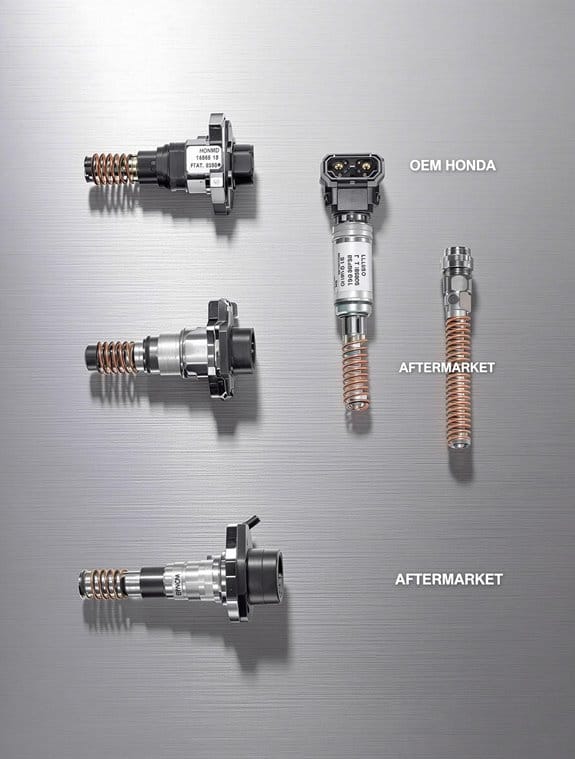
When choosing a sensor for your Honda Accord, you’ll need to carefully verify compatibility with your specific model year and engine type through the manufacturer’s specifications. You should weigh the benefits of OEM parts, which offer reliable quality and direct fitment, against aftermarket options that might provide cost savings but require more research into warranty coverage and installation requirements. The complexity of installation, ranging from simple plug-and-play to those requiring specialized tools or expertise, will impact your total cost and should factor into your price-quality assessment.
Sensor Compatibility Verification
Selecting a compatible sensor for your Honda Accord requires careful verification of multiple factors to ascertain proper fit and function within your vehicle’s specific systems. You’ll need to cross-reference the OEM part numbers with your existing sensor to confirm an exact match for your model and engine configuration.
When verifying compatibility, review the manufacturer’s specifications and vehicle fitment lists, which often include both Honda and Acura applications that share similar platforms. It is crucial to check not only the model year but also your specific engine type, as sensor requirements can vary between different powertrains. You’ll also want to research installation requirements and consult user reviews that confirm successful fitment with your particular Accord model, preventing potential compatibility issues after purchase.
OEM Vs Aftermarket Parts
Making an informed choice between OEM and aftermarket sensors for your Honda Accord requires understanding the key differences in quality, reliability, and long-term value between these two options.
When you’re considering OEM sensors, you’ll benefit from their precise fit and consistent quality, as they’re manufactured to the exact specifications of your vehicle. While you’ll pay more upfront for OEM parts, they typically offer better value over time by preventing recurring check engine light issues and maintaining peak performance. Your vehicle’s resale value can also increase when you stick with OEM components, as potential buyers often prefer cars with original manufacturer parts. In contrast, aftermarket sensors may cost less initially but can lead to compatibility issues, inconsistent performance, and potential long-term reliability concerns that could affect your Accord’s operation.
Price-Quality Balance Assessment
A successful price-quality balance assessment for your Honda Accord’s sensors requires evaluating multiple factors beyond the initial price tag. While aftermarket sensors might seem appealing with their lower costs, ranging from 30-50% less than OEM parts, you’ll need to weigh the long-term implications of your choice.
OEM Honda sensors, typically priced between $100-300, offer superior calibration precision and durability that can prevent recurring issues with engine codes. You’ll benefit from manufacturer warranties that often extend to one year or more, providing additional value protection. When analyzing total ownership costs, factor in that genuine Honda parts consistently demonstrate higher reliability rates and reduced maintenance frequency compared to aftermarket alternatives, which may require more frequent replacements despite their lower upfront cost.
Installation Complexity Level
Understanding the installation complexity level of Honda Accord sensors represents a critical factor in your decision-making process, as different sensor types demand varying degrees of technical expertise and specialized tools.
When you’re evaluating sensor options, you’ll need to take into account whether you’re equipped to handle installations that require specific tools, such as the 27mm wrench and long bent needle nose pliers needed for knock sensor replacement. Before starting any installation, you’ll want to watch instructional videos to familiarize yourself with the procedure and confirm you have all necessary equipment. While some sensors, like MAP sensors, offer relatively straightforward installation processes that you can manage independently, others may require professional expertise. Remember to let your vehicle cool completely before beginning any sensor installation to maintain safety throughout the process.
Warranty Coverage Details
When evaluating warranty coverage for Honda Accord sensors, you’ll need to carefully examine the terms and conditions offered by different manufacturers, as coverage periods can range from basic 12-month guarantees to more detailed multi-year protection plans.
You’ll find that OEM sensors typically come with more thorough warranty coverage than aftermarket alternatives, which can be an essential factor in your decision-making process. Before finalizing your purchase, make sure to document all installation procedures and maintain service records, as warranty claims often require this documentation for validation. While comparing options, remember that manufacturers who offer longer warranty periods often do so because they’re confident in their product’s reliability and performance, making extended coverage a potential indicator of sensor quality and durability.
Material Quality Analysis
Material composition stands as one of the most vital factors you’ll need to evaluate when selecting factory sensors for your Honda Accord. When examining sensor materials, you’ll want to focus on options that feature double laser-welded stainless steel bodies or high-quality ABS plastic, as these materials provide superior resistance to corrosion and environmental stress.
The durability of your sensor’s materials directly impacts its ability to maintain accurate readings of essential parameters like oxygen levels and air pressure. You’ll find that sensors constructed with premium materials often deliver better sensitivity and stability across varying conditions, while meeting or exceeding OEM specifications. By choosing sensors made from robust materials, you’re reducing the risk of premature failure and minimizing future maintenance costs through fewer replacements.
Performance Impact Evaluation
Selecting the right factory sensors for your Honda Accord directly impacts your vehicle’s overall performance, fuel efficiency, and long-term reliability. When evaluating performance impact, you’ll find that OEM-quality sensors deliver superior precision in air-fuel ratio measurements, which translates to enhanced engine efficiency and responsiveness.
Your vehicle’s performance benefits considerably from sensors featuring double laser-welded stainless steel construction, as they maintain accuracy even under extreme temperature conditions. You’ll notice improved drivability and fewer check engine light occurrences when using factory-tested sensors that meet OEM specifications. While aftermarket options might seem cost-effective initially, investing in genuine parts typically results in better long-term performance outcomes, with sensors maintaining their calibration accuracy and providing consistent readings throughout their service life.
Frequently Asked Questions
How Long Does It Typically Take to Install a New Sensor?
You’ll typically spend 30-60 minutes installing a new sensor, though the exact time depends on the sensor’s location and your experience level. While easily accessible sensors like oxygen sensors might take just 20 minutes, others buried deep in the engine bay could require 2+ hours. It’s essential to follow your vehicle’s service manual and verify proper calibration after installation to guarantee peak performance.
Can I Replace Multiple Sensors at Once Without Causing System Errors?
You can safely replace multiple sensors simultaneously, but you’ll need to follow a strategic approach to avoid triggering system errors. First, disconnect your car’s battery to prevent electrical issues, then replace sensors that work together in related systems, such as oxygen sensors or temperature sensors. After installation, you’ll need to use a diagnostic scanner to clear any stored codes and verify proper sensor communication.
Will Using Aftermarket Sensors Void My Honda Warranty?
While genuine Honda parts provide guaranteed compatibility, aftermarket sensors won’t automatically void your warranty. The Magnuson-Moss Warranty Act protects your right to use aftermarket parts. However, if an aftermarket sensor causes damage, Honda won’t cover those specific repairs. You’ll need to prove the sensor wasn’t responsible for any issues. To maintain peace of mind, consider using Honda-approved sensors for critical systems like emissions and safety components.
What Tools Do I Need to Replace These Sensors Myself?
To replace Honda Accord sensors yourself, you’ll need basic hand tools including a socket set with various sizes, flathead and Phillips screwdrivers, and pliers. You’ll also want an OBD-II scanner to clear any sensor-related codes. It’s helpful to have wire strippers, electrical tape, and dielectric grease for connector maintenance. Don’t forget safety equipment like gloves and safety glasses, and you’ll need jack stands if accessing undercarriage sensors.
How Often Should I Perform Preventive Maintenance Checks on These Sensors?
You’ll want to inspect your vehicle’s sensors every 30,000 miles or 2 years, whichever comes first, to catch potential issues before they become catastrophic failures. During routine oil changes, have your mechanic scan for sensor diagnostic codes, which can reveal early warning signs. For peak performance, visually check sensor connections and wiring every 6 months, looking for corrosion, loose connections, or physical damage that could impact their function.


